Story
The Paper Moon
At seven minutes to curtain, the moon would not rise.
It was a paper circle the size of a bicycle wheel, painted cream on one side and fitted to a length of fishing line. Ivo, who had made it, pulled the line. The moon lifted two inches and came down again.
“Try asking nicely,” said Nadiya.
“I made it. It knows what I think of it.”
Nadiya was playing the queen, although the crown was still in her handbag and she had one bare foot. She leaned against the ladder while Ivo climbed to the lighting bar.
The trouble was not the moon. The trouble was a knot at the top of the line, pulled hard into the eye of the screw. He could see the place where the line had doubled back on itself. He could not reach it without taking down the painted sky, and he could not take down the sky without blocking the door through which the king had to enter.
Below him, the king was looking for his sword.
“Four minutes,” called the stage manager.
Ivo climbed down. “We can cut it. Put the moon up before the play starts.”
“In the first scene,” said Nadiya, “the moon is supposed to be new.”
“Then we can leave it down.”
“In the last scene, I tell it all my troubles.”
“Tell the ceiling.”
“I have. It keeps giving advice.”
The king found his sword under a chair. The stage manager found Nadiya's missing shoe under the king. The audience was making the particular sound a room makes when it has decided to be patient but is discussing the decision among itself.
Ivo cut the line. He carried the moon behind the scenery, where the audience would not see it, and put it on a stool. The queen went to find her crown.
The first scene began without a moon. The second scene also began without a moon, though the script did not specify one either way.
During the interval Nadiya came backstage carrying a tray of paper cups. She offered Ivo one, set the tray down, and looked at the moon.
“Could somebody hold it?”
“Where?”
“Behind the window.”
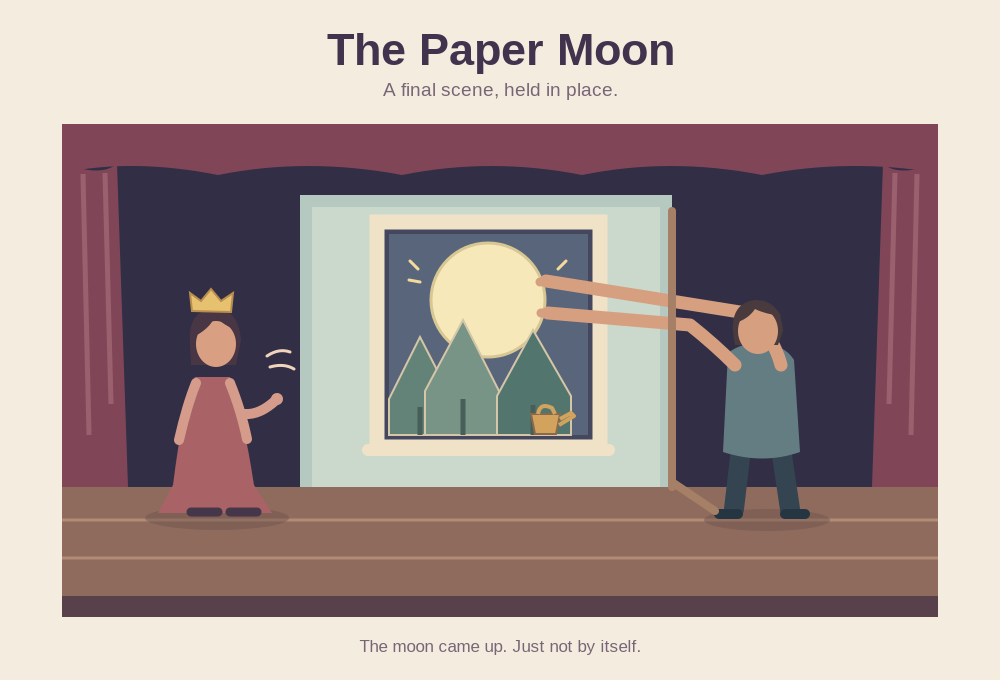
The window was a square cut in a painted wall. In the final scene it looked onto a garden, represented by three cardboard trees and a watering can someone had forgotten to move. Ivo stood behind the wall and raised the moon into the square. It filled nearly all of it.
“Too big,” he said.
“Move back.”
He moved back. The moon became smaller. The watering can became visible again.
“Perfect,” said Nadiya, and carried the cups away before he could object.
At the end of the play he held the moon above the trees. Nadiya spoke to it through the window. From where he stood he could see only the back of her crown and the audience in the gap between two flats. A child in the front row leaned sideways to see around a grown-up’s hat.
Ivo kept his arms still. His left shoulder began to ache. The queen went on talking, and then she stopped. There was a moment in which nothing moved except the paper moon, which trembled a little because Ivo's arms were tired.
After the applause, the child came to the edge of the stage with a parent and asked whether the moon was supposed to shake.
“No,” Ivo said.
“Yes,” said Nadiya.
They looked at each other.
“It was supposed to come up,” Ivo said.
“And it did,” said Nadiya. “Just not by itself.”
The child considered this, then asked whether the watering can was supposed to be there.